
Elasticvue 2.0: What's next?
Nine years after the first commit, Elasticvue has grown from a hobby project into a tool used by thousands of developers every week. I’m currently working on Elasticvue 2.0: a big redesign, better cluster monitoring, and new diagnostic tools. If you noticed that releases have slowed down: Elasticvue is not abandoned, more on that below. But before going into detail, let us look at how we got here.
The road so far
I started developing Elasticvue in the summer of 2017 because I was interested in learning Vue.js. I was also frustrated with Kibana at the time: it was way too complicated for a junior developer who just wanted to see the documents in his local Elasticsearch cluster. The first commit was done on “Tue Aug 8 16:20:33 2017 +0200”, with the helpful message: “Initial commit” - and so Elasticvue was born.
Like most developers, I never got particularly good at naming things. Because it started as a personal project, I just named it “Elasticvue”, describing its tech stack. Today, nine years later, the name has stayed the same, but that’s about it.
I made many mistakes in the early days of Elasticvue. I replaced the entire UI library at least five times (jumping between Vuetify, vue-material, and Quasar), spent countless hours debugging webpack and eslint upgrade issues, moved the storage from localStorage to WebSQL to IndexedDB… just to name a few.
But I also learned how to maintain a project, how open-source development works, and what kind of weird data users index into their Elasticsearch cluster, breaking Elasticvue on so many occasions.
Over 300 issues and more than 50 pull requests later, Elasticvue has grown into one of the most widely used Elasticsearch frontends available.
Elasticvue today
So far, I have released 110 versions of Elasticvue (as of Elasticvue 1.16.0), and the project has over 2,800 stars on GitHub.
Elasticvue is now available as a browser extension, desktop app, Docker container, hosted web app, and through several package managers. Keeping all these distribution channels working produces more work than developing the application itself (looking at you, Apple!).
The desktop app, in particular, was one of the most requested features for many years. Weirdly enough, fewer than 20% of Elasticvue’s users actually prefer it. Which brings us to some numbers.
All user numbers are based on Elasticvue’s built-in update check, which uses a randomly generated identifier to estimate the number of unique users. The data goes back to Elasticvue 1.5.0, released on March 14, 2025. No information about your Elasticsearch clusters or documents is transmitted. You can find more details in the privacy documentation.
Statistics could not be loaded. Please try again later.
Unique users per week
As of October 2026, Elasticvue has roughly 15,000 - 20,000 unique users per week, or 4,000 - 5,000 per day. Of these users, 80% use the browser extension, 15% the desktop app, and 3.7% the Docker image, with the remaining split between the hosted web app and self-hosted versions.
Most of the users are on Windows (57%), with macOS at 32% and 10% on Linux. These are great numbers for something that started as a hobby learning project, and I hope to see them grow in the future.
Operating systems
Build types
You can see all user statistics here.
Fewer releases, but not abandoned
So, what does the future bring for Elasticvue? Looking at the number of releases, we can see that development has slowed down quite a bit. The peak was in 2018 with 25 releases that year, compared to 15 releases in 2024 and just 5 so far in 2026. This does not mean that Elasticvue is abandoned, nor will it be in the foreseeable future. Elasticvue is mature, stable, and currently covers what most people need based on bug reports and feature requests. There is simply less to release.
But that doesn’t mean there’s no room for improvement, no way to distinguish Elasticvue from the alternatives, or no plan for the future. Speaking of which…
What’s new in Elasticvue 2.0
A new look. The navigation moves to a sidebar, there’s a new layered dark theme, and the colors and type are cleaner. Almost every page has been redesigned, and most now open with a short overview of the numbers that matter.
A dashboard that tells you what’s wrong. You get cluster status, CPU, heap and disk, search and indexing rates and latency, and your busiest nodes and largest indices. Elasticvue also checks your cluster for common problems, like unassigned shards, disk watermarks, index blocks, thread pool rejections, JVM pressure and mixed node versions. If something is off, you’ll see it on the dashboard.
Tools to fix it. The Tools page is back. Use it to explain unassigned shards and retry failed allocations, drain a node before shutting it down, change replicas or the refresh interval, or adjust disk watermarks and recovery bandwidth, all without writing the API calls yourself.
All your clusters at a glance. A new overview shows health, CPU, heap, disk and shards for every cluster you’ve configured.
A completely new search. This one I’m most excited about:
- A query bar that autocompletes fields, values and recent queries. You can also switch to DSL, SQL or ES|QL.
- A time picker and a histogram for time based data like logs or datastreams.
- Filters you can add and toggle with one click.
- A document view that shows the documents around a hit.
- Search across indices, aliases and data streams.
- Saved searches and history, export to CSV or JSON, and “copy as cURL”.
A better REST page. It autocompletes paths and has a query library with your history, saved queries and examples.
Below you can see a first screenshot of what’s to come:
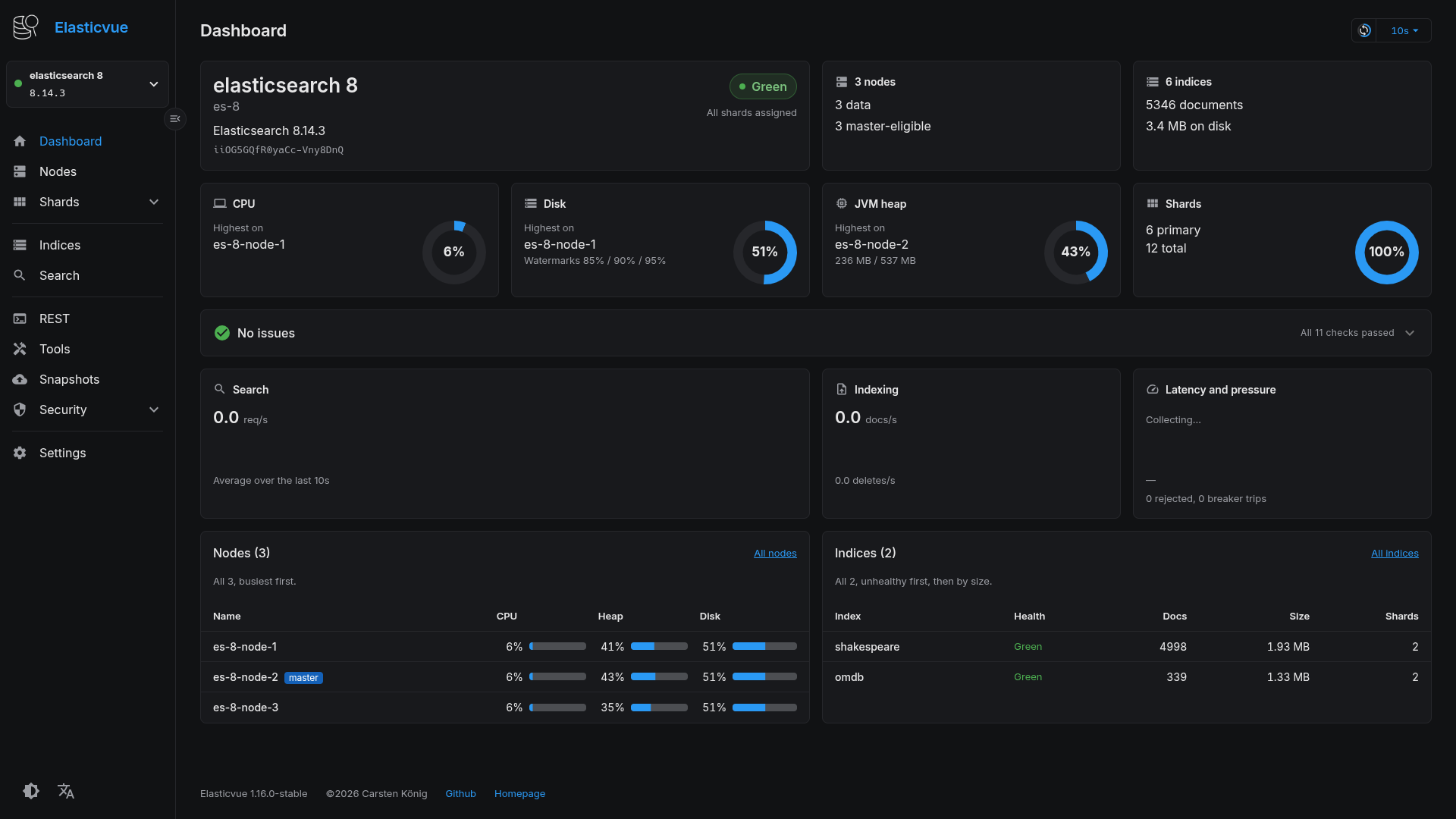
Want to try it yourself? Check out the beta at beta.elasticvue.com.
What won’t change?
This doesn’t mean that you won’t recognize Elasticvue. Many things will stay the same, most importantly everything that is not the frontend itself. Elasticvue will remain open source and MIT-licensed. There are no plans to introduce tracking or analytics beyond the existing update check. Your privacy and your data will always be a priority.
Elasticvue 2.0 is still a work in progress, and nothing is set in stone yet. I plan to release it before the end of the year.
If you have ideas, feedback, or features you’d love to see in Elasticvue 2.0, please join the discussion on GitHub.
Thank you for using Elasticvue.
Carsten