
Elasticvue 2.0
The Road so far
I started to develop elasticvue in the summer of 2017 because I was interested in learning Vue.js. I was also frustrated with Kibana at the time: it was way too complicated for a junior developer that just wanted to see the documents in his local elasticsearch cluster. The first commit was done on “Tue Aug 8 16:20:33 2017 +0200”, with the helpful message: “Initial commit” - and so elasticvue was born.
As most developers i never got particularly good at naming things, and because it started as a personal project, i just named it “elasticvue”, describing its tech stack. Today, nine years later, the name stayed the same, but that’s about it.
I made many mistakes and stupid decisions in the early days of elasticvue. I swapped out the whole UI library at least five times (jumping between Vuetify, vue-material, and Quasar), spent countless hours debugging webpack and eslint upgrade issues, moved the storage from localStorage to WebSQL to IndexedDB… just to name a few.
But i also learned how to maintain a project, how open-source development works, and what kind of weird data users index into their elasticsearch cluster, breaking elasticvue on so many occasions.
With great commit messages like “adds todos”, “not working yet”, or “remove broken spec”, over 300 issues, and more than 50 pull requests on github, elasticvue has grown to one of the most used elasticsearch frontends available.
Elasticvue today
So far i have released over 100 versions of elasticvue, 110 to be exact (as of elasticvue 1.16.0). Elasticvue has over 2800 stars on github (what a great metric that is).
It is available through so many channels that i often forget some of them myself. The full list, hopefully, is:
- Web app
- Chrome web store
- Firefox Addon
- Edge extension store
- Mac desktop app
- Linux desktop app
- Windows desktop app
- Mac Homebrew
- Archlinux AUR
- Flatpak (via flatpark)
- Docker container
- Self hosted
While most of these are automated via github actions, almost every time at least one of them breaks and causes a huge headache for me when i just want to quickly release a small hotfix (looking at you, apple!).
Especially the desktop app was one of the most requested features for many years. Weirdly enough not even 20% of elasticvue’s users actually use it. Which brings us to some numbers.
Statistics could not be loaded. Please try again later.
Unique users per week
As of October 2026, elasticvue has roughly 15.000 - 20.000 unique users per week, or 4000-5000 per day. Of these users, 77% use the browser extension, 17% the desktop app, and 4% the Docker image, with the remaining split between the hosted web app and self-hosted versions.
Most of the users are on windows (58%), with macos at 32% and 10% on linux. In terms of the browser extension i see 75% on chrome, 13% on edge and only 12% on firefox. I think these are great numbers for something that started as a hobby learning project, and i hope to see these numbers growing in the future.
Operating systems
Build types
The Future
So, what does the future bring for elasticvue? Looking at the amount of releases, we can see that development has slowed down quite a bit. The peak was in 2018 with 25 releases that year, compared to 15 releases in 2024 and just 5 so far in 2026. This does not mean that elasticvue is abandoned, nor will it be in the foreseeable future. Elasticvue is mature, stable, and currently covers what most people need based on bug reports and feature requests.
Which does not mean that there is no room for improvement, no room to distinguish it from other alternatives or no plan for whats next. Speaking about that…
What’s next?
Personally, I have always seen elasticvue as a data- and document-oriented tool. It was never perfect for cluster admins that need to debug issues in their 400-node cluster; it is used by developers and small teams to quickly and easily investigate indices and documents. But having administered clusters myself recently, I asked myself: why not? Can’t it be both, without losing what users currently love?
I think the answer is a big yes. Elasticvue 2.0 will include some great features:
- UI Redesign (Sidebar instead of top navigation, style and color upgrades)
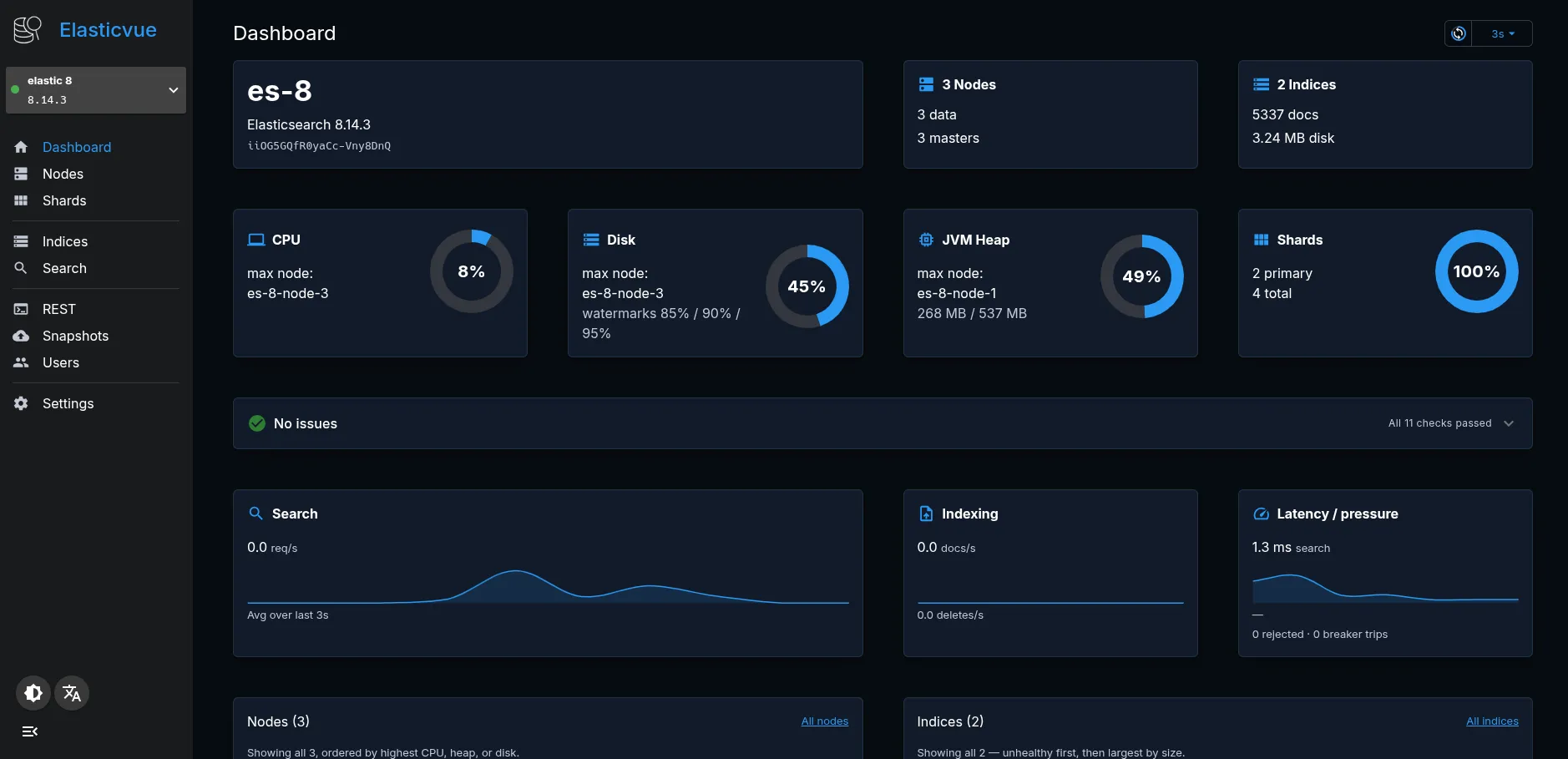
- Completely redesigned dashboard. See what’s actually going on in your cluster instead of staring at useless version numbers and UUIDs
- New “Diagnosis” page and revival of the “Tools” page. What’s wrong with your cluster, what issues are caused by it, and how do you fix it?
- New cluster overview, to see the status of all your clusters at once
This doesn’t mean that you won’t recognize elasticvue. Many things stay the same, most importantly everything that is not the frontend itself. Elasticvue will stay open source, keep the MIT license, will not introduce tracking or analytics (apart from the already existing update check) and will always respect your privacy and your data. Below you can see a first screenshot of what’s to come:
Thank you for using elasticvue.
Carsten